India Drums! We love rhythm, we love percussion, we love drumming, and we idolize, appreciate, and celebrate our drummers. We’ve got the top favorites from our classical music traditions such as the Tabla, Mridangam, Ghatam, Kanjira, Morsing, and Kartal. These instruments are played solo and/or as an accompaniment to an ensemble, and their spirit continues to thrive in modern experiences like a drum circle Mumbai, where collective rhythm brings people together. However, here’s where the real party is. What we (maybe over simplistically) classify as folk percussion instruments: We have the Dhol Tasha tradition of Maharashtra, the Chenda drummers of Kerala, the Dhol drummers of Punjab and Gujarat, or the Dhak drummers of West Bengal. The major difference is that these drums are played in groups, almost never alone or individually. That’s where the true essence, benefit, and transformative power of drumming lives something beautifully experienced today in a drum circle Ahmedabad, where collective rhythm and community energy come alive.

With so many diverse cultures in our country, it is but natural that we have many cultural music events in India. For those of you who live in Pune (like I do), you would all have heard, played, supported, or danced in a dhol tasha pathak. This is truly a one-of-a-kind experience. Right from the rehearsals that start a month before the Ganesh festival, the experience of making (assembling) your drum, to drumming in the processions for hours despite rain or time of the day, it’s all an unforgettable time indeed to experience the dhol tasha history an energy that continues today through collective experiences like a drum circle Chennai, where rhythm connects people beyond tradition. One truly does get to experience the feeling of being in a flow state, forgetting about all thoughts, time (sometimes food!), and of belonging to something larger than themselves. This yearly activity helps many people from different walks of life unplug from their daily routines and recharge their own batteries. This shows us the importance of music in our Indian culture. No matter which state you are from, there is some form of group drumming that is associated with a festival of some sort. This is a privilege if you ask me. Many cultures may go a lifetime without experiencing the thrill of being a part of something like this. Indian drumming traditions are rich and have been passed on from one generation to another. This is like medicine for the soul. So next time you are contemplating being a part of a group drumming procession—or even joining a drum circle Goa—just do it!

Just like the djembe drum history is linked with Guinea, the 13th century, the Mandingue region of West Africa, and is deeply entrenched within the fabric of life, the evolution of drumming in India is mainly attributed to the existing folk drumming traditions. Two particular drumming cultures that have caught my fancy lately are the Parai Attam drumming tradition of Tamil Nadu and the Chenda drummers of Kerala. This is truly a sight to watch and feel, much like the shared energy experienced in a Delhi drum circle, where rhythm brings communities together. Similar to the West African djembe drumming concept of every rhythm having a story, belonging to a particular ethnic group and carrying deep meaning, this is true of the Parai Attam and Chenda styles as well. There are particular rhythms that accompany marriages, village celebrations, harvests, message communication, and the welcoming of visitors to the village. It just goes to show: we are all one BIG drumming family. The chenda drumming rhythms sound (broadly) like a western marching band. You have the concept of bass (low chenda) drummers, mid/tom (mid chenda) drummers, snare (high chenda) drummers, and cymbals. I challenge you to simply listen to these rhythms and not move it’s so groovy, it’s difficult not to dance, just like the infectious energy experienced in a drum circle Mumbai.

Since I’ve been geeking out with my group drumming research looking for the evolution of drumming and cultural music events in India, here’s what I have learned

As a country, we love to drum with each other, with large groups of people. In most cultures, we gather together (once a year at least) to drum and form a procession of some sort that has a purpose that is cultural, spiritual, religious, and (more nowadays) recreational and therapeutic an experience beautifully reflected in a drum circle Ahmedabad, where collective rhythm creates connection and shared joy.

Community building was always at the core of these activities and processions, even though we did not consciously call it that. We are very good at community building, networking, supporting, and seeking help from the community something that continues to thrive today through experiences like a drum circle Chennai, where rhythm naturally brings people together.

Musically, the concept is like most global group drumming cultures. We have a bass drum, a high-pitched drum, a cymbal sound, and a dance. I will work on musically breaking down the concepts of a group drumming procession more in the next blogs, much like the collaborative rhythm experienced in a drum circle Goa, where every sound and movement comes together as one.

These sessions are inclusive, open to all, and entail a process of training. Not all who participate are professionals; the experienced ones help train the beginners. Knowing or (mostly) unknowingly, the rhythms develop a very human and feel-based ‘swing,’ which is a result of many people drumming together over a period of time and ‘feeling’ the music or the pulse in a particular way. This ‘swing’ is tough to musically notate, and it is important to trust one’s ear to develop that sense of ease while playing. This feel is rarely taught but felt and absorbed something beautifully experienced in a drum circle Mumbai, where collective rhythm naturally shapes the groove.

Stress reduction, catharsis, experiencing a flow state, building connections, and having epiphanies and realizations are all part and parcel of the gifts that this process gives you. Look for it and you may not find it. Trust the process, and when the time is right, you will realize that what you seek is seeking you an experience often felt deeply in a drum circle Ahmedabad, where rhythm becomes a pathway to self-discovery.

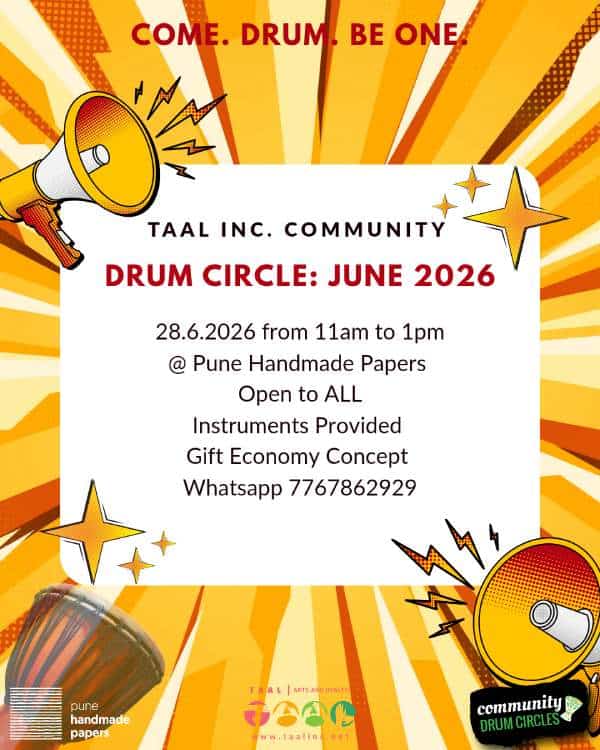
Moral of the story – Find a drum circle near you (and now there are many everywhere. Simply Google ‘drum circle’ and you should find a group near you) and go out there to drum. If there’s no drum circle in your city, write to us, participate in our annual course, learn how to lead groups using rhythm, and start your own drum circle community just like a growing drum circle Chennai movement bringing people together through rhythm.