
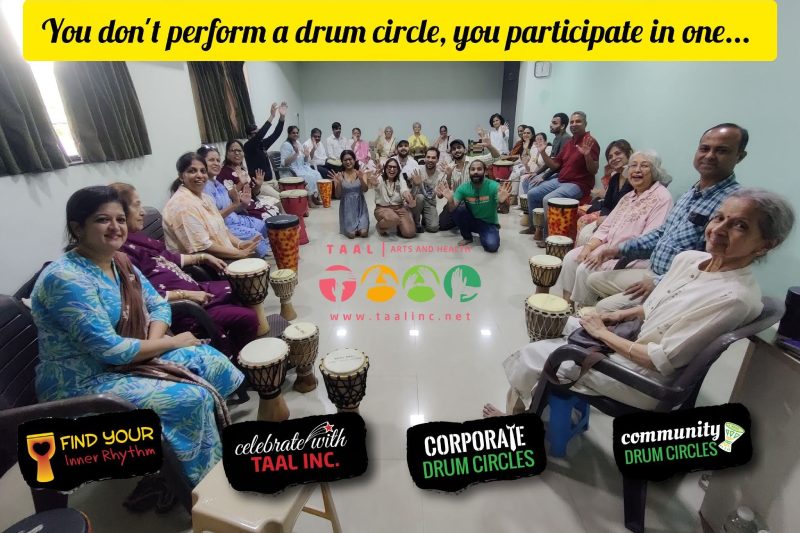
“Let’s perform a drum circle…!” Of all the drum circle-isms this one is the funniest… Why, you ask? Well, that’s because it does a disservice to both; a drum circle and a percussion ensemble performance. More importantly, it overlooks the true essence of drum circles as powerful experiential learning activities built around participation, expression and connection.
Of late, I’ve come across a host of drum circle companies, facilitators and community groups where there seems to be some misunderstanding about what the activity is and what it is not, especially when it comes to understanding the true purpose of drum circle activities. So I thought that I would use this space for some awareness building…
First of all, drum circles or group drumming sessions don’t even need to be facilitated. Yup, you read that right. What is a drum circle but a culturally relevant group drumming activity? In many ways, some of the earliest drum circle ideas music therapy concepts emerged naturally in communities coming together through rhythm and connection. It all started when a group of people got together and played drums and percussion instruments to accompany a social event or ceremony. In many ways, the spirit of drum circle India traditions can still be seen in communities coming together through rhythm, celebration and shared experiences. Here the activity that the drumming accompanied took centre-stage and the drummers played to keep the energy up and the focus stationed on the ceremony. Of course these drummers got noticed for their abilities and flamboyance but most importantly this was their service to the community.
With the evolution of drum circles or group drumming sessions (mostly led by a facilitator) with a strong focus on some pre decided behavioural (or non musical) objective, we started explicitly highlighting the benefits of this activity due to the ease with which the participants could experience these goals naturally, without having to be told how or what to feel. This is also why concepts like drumming for emotional wellness have gained so much relevance in recent years. How organically and effortlessly the participants are taken on this journey to experience this goal without over emphasizing the role of the self is admittedly the expertise of the facilitator. And this is invisible: the work that the facilitator has put into their training. The client is usually only concerned with superficial outcomes and the untrained facilitator is probably preoccupied with ensuring that everyone is only drumming together. This is where even powerful experiential learning activities may feel, look and sound good for a while, for one time, but may be short lived both in the eyes of the client and the facilitator.
Bottom line
You don’t perform a drum circle, you participate in one…
You don’t perform a drum circle, you express in one…
You don’t perform a drum circle, you feel a sense of catharsis in one…
As a facilitator, you may wear the cap of a teacher, a performer, a leader, an orchestrator, a conductor or a co-participant at various points in the session. This ability to shift roles seamlessly is what gives meaningful drum circle activities their depth and impact. When to do what and for how long is a result of your training as a drum circle facilitator.
If you’ve focussed only on the musical aspects of a group drumming session (in a non musical setting) please ensure that you have the qualifications to do so. You’ll need a bachelor’s or master’s in music performance, drumming in the least. This distinction becomes especially important when people begin exploring drum circle ideas music therapy and other rhythm-based wellness practices without proper training or understanding. Just as you would like to have a trained surgeon operate on you in case of a medical emergency and not a paramedic, right?
Here’s a video of a community drum circle session where I was very happy to spend more time outside the circle than inside. The rhythm was cooking and interacting and developing naturally. The fact that the group doesn’t need you in the center is a good thing. It shows the time and energy you are spending listening and calibrating what the group wants and needs (as opposed to what you need)
If any of this is ringing true to you and you’d like to learn this art of drum circle facilitation, get in touch with me on WhatsApp on 7767862929 and ask about the Find Your Inner Rhythm Intensive Course. I’ve trained a lot of facilitators since 2014 and will be happy to share more information with you
Come. Drum. Be One.
Varun Venkit
Team Taal Inc.

Varun is the founder and director of Taal Inc.
The visionary behind the motto
Come. Drum. Be One.
To read more about him Click Here